


To access the full paper, download the PDF on the left-hand sidebar.
Introduction
In recent months, print and television journalists have presented the American public with a “crisis” of illegal immigration on the U.S.–Mexico border. Much of this recent discussion has centered on Central American children traveling alone and on allegations that they are responding to motivations created by the Obama administration’s Deferred Action for Childhood Arrival policy. The word “crisis,” however, can have alternative meanings. If a “crisis” of undocumented immigration means a historically large or very rapidly growing flow of undocumented immigrations, the overall national evidence shows today that there is no such crisis. Border Patrol apprehensions of undocumented immigrants attempting to cross the U.S.–Mexico border have in fact plummeted and remain far below levels a decade earlier.
Nevertheless, apprehensions of children traveling alone have indeed surged. Many of these child immigrants are traveling alone from Guatemala, El Salvador, and Honduras. This flow of children from Central America requires careful examination, especially if compared to Mexico’s numbers. Although Mexico’s population is eight times Guatemala’s, 15 times Honduras and 19 times El Salvador’s, for example, the most recent partial-year apprehensions of unaccompanied children from each one of these countries have exceeded such apprehensions of children from Mexico. All this points to a surge of unaccompanied Central American children. But even this has to be qualified as a true crisis or not. While references to a record of apprehensions of unaccompanied child immigrants are correct, publicly available data for this category only go back to 2010. Thus, it may be preliminary to draw definitive conclusions about record numbers of unaccompanied children based on four full-fiscal-year observations plus monthly observations into a fifth year. Other data, including total apprehensions for any undocumented child immigrants, accompanied or otherwise, extend more than a decade. Preliminary estimates for fiscal year 2014 suggest that these apprehensions have remained below levels a decade earlier.
Figure 1 — U.S. Border Patrol Sectors
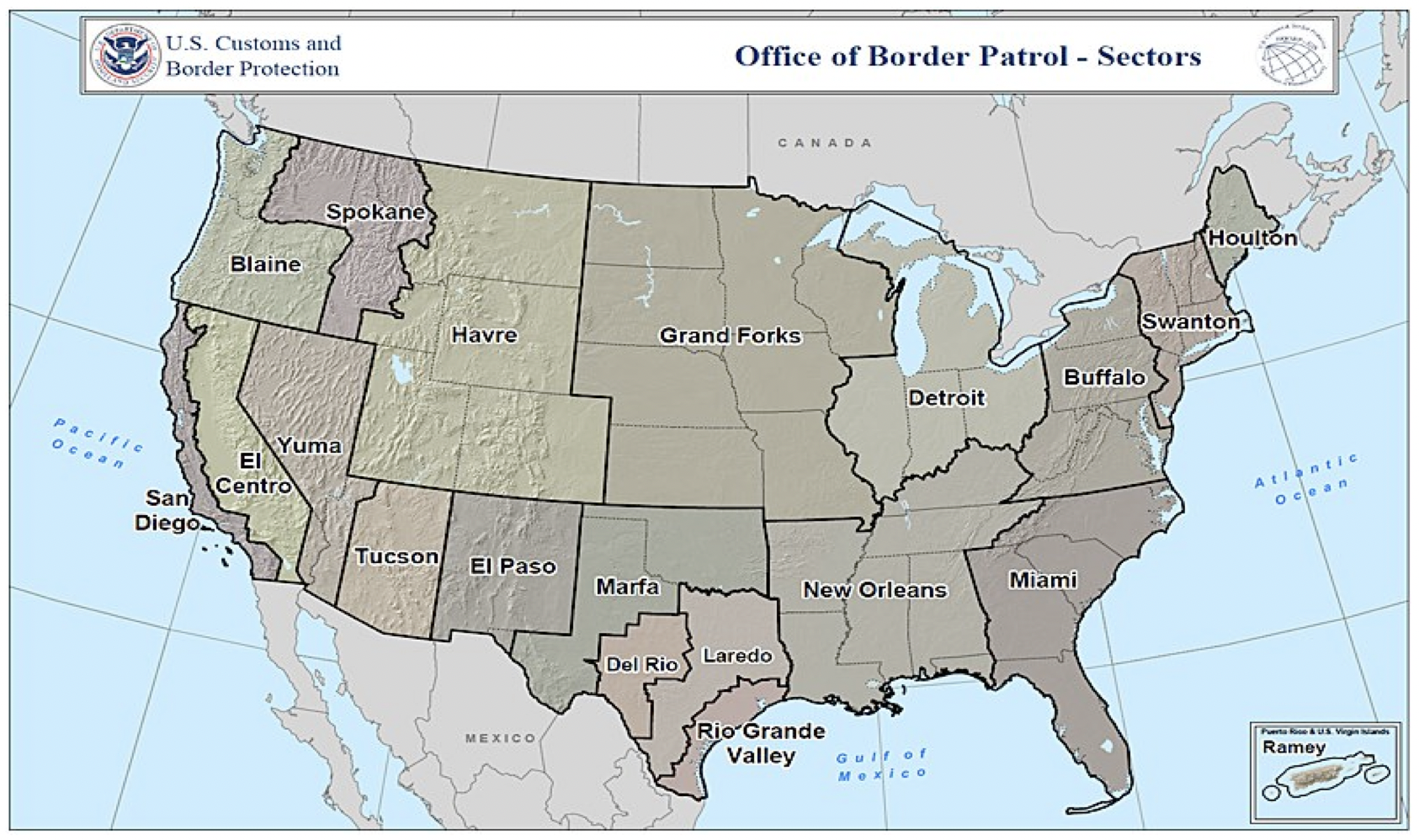
One basis for misunderstanding what has been taking place on the border involves the large changes in overall apprehensions and child apprehensions from one region of the border to another. In this paper, we chart large shifts in apprehensions from the western portion of the U.S.–Mexico border (Yuma and Tucson sectors) to its extreme southeastern section (particularly the Rio Grande Valley sector). The map above presents the U.S. Border Patrol’s nine geographic U.S.–Mexico border sectors, to which we give sector-by-sector attention in later sections of this paper. Moving from west to east, these sectors include San Diego, El Centro, Yuma, Tucson, El Paso, Marfa, Del Rio, Laredo, and the Rio Grande Valley. Overall, apprehensions of undocumented immigrants crossing the border from Mexico to the United States increased 26.5 percent (12.5 per year at a compound rate) between 2011 and 2013. This overall change constitutes an increase of almost 87,000 apprehensions. However, a major shift in apprehensions has occurred across the sectors on the map. Apprehensions in the Rio Grande Valley sector, seen on the map along the southernmost portion of the Texas–Mexico border, rose by a little more than 95,000. This signifies that the remaining eight sectors, on net, saw a decline of about 8,000 apprehensions. As we discuss, the real reductions came in the westernmost sectors.
Before commencing our analysis, a caveat is in order. We want to emphasize that apprehensions of undocumented migrants do not tell us how many persons actually crossed the border without authorization. Undocumented migrants who were not caught crossing the border were also often able to avoid capture later in their routes, so we do not know how many successful crossers there have been. Generally, the research community that studies such topics concludes that when apprehensions go up or down, so do overall crossings. We will assume this much in our analysis.
This material may be quoted or reproduced without prior permission, provided appropriate credit is given to the author and Rice University’s Baker Institute for Public Policy. The views expressed herein are those of the individual author(s), and do not necessarily represent the views of Rice University’s Baker Institute for Public Policy.


